Introducing Mind Clone: Your Digital Mind Replica
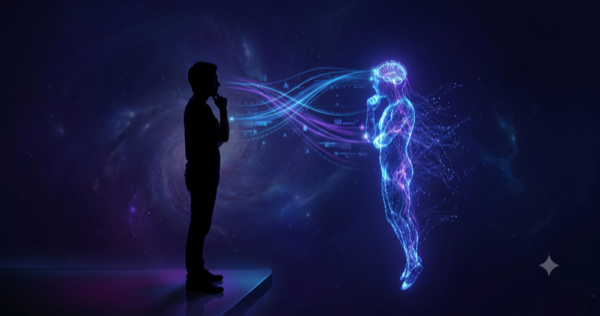
What if you could have a conversation with yourself? Not a recording, not a chatbot with pre-written responses — but a genuine digital reflection of your mind: one that writes the way you write, makes decisions the way you decide, and generates ideas from your unique cognitive perspective. This is Mind Clone, Neuralith AI Studio's most ambitious project to date. Built on top of our all-in-one multi model AI platform — which already seamlessly integrates GPT-4o, Claude 3.5, and Gemini 2.0 into a single unified workspace — Mind Clone adds a layer of deep personalization that makes the AI feel less like a tool and more like an extension of yourself.
🧠 What is Mind Clone?
Mind Clone is a personalized AI system that learns your thought patterns, writing style, decision-making processes, and knowledge base to create a digital replica of how you think — not a generic chatbot, but an AI that reasons the way you do. It exists under the Neuralith AI Studio umbrella, leveraging our multi-model architecture to give your digital self access to the combined intelligence of GPT-4, Claude, and Gemini.
Beyond Generic AI: The Problem with One-Size-Fits-All Assistants
Every major AI assistant on the market today — ChatGPT, Claude, Gemini, Copilot — treats every user identically. Whether you're a software engineer debugging complex distributed systems or a marketing director crafting brand strategy, the AI responds with the same tone, the same level of technical depth, and the same generic reasoning patterns. You can influence this somewhat with system prompts and custom instructions, but the core intelligence remains impersonal. It knows about the world, but it doesn't know about you.
This impersonal approach creates friction. You spend the first few exchanges of every conversation re-establishing context — explaining your role, your preferences, your communication style. You correct the AI when it makes assumptions that don't fit your use case. Over time, you develop workarounds: saved prompt templates, carefully crafted system messages, external note files that you paste into every new chat. These are bandaids on a fundamental limitation: the AI doesn't remember who you are across sessions, let alone learn from your patterns over time. Mind Clone is designed to eliminate this friction entirely by building an AI that fundamentally understands your cognitive fingerprint.
How Mind Clone Learns Your Cognitive Fingerprint
Mind Clone's learning process is built on several layers of data collection and model adaptation, all designed with privacy and user control as foundational principles. The system begins by analyzing your written communication — emails, documents, chat messages, code comments — anything you choose to share. It identifies patterns in your vocabulary, sentence structure, formality level, and argumentation style. Do you prefer direct, bullet-pointed communication or narrative, context-rich prose? Do you lead with data or with intuition? Do you favor consensus-building language or decisive declarations? These subtle patterns form the linguistic layer of your cognitive fingerprint.
Beyond language, Mind Clone observes your decision-making patterns within the Neuralith AI Studio environment. When you evaluate AI-generated outputs, which versions do you accept and which do you revise? When the platform's smart routing system selects a model for your query, do you override the choice or let it stand? Over dozens of interactions, these micro-decisions paint a detailed picture of your preferences, risk tolerance, and quality standards. The system learns, for example, that you're willing to sacrifice some stylistic polish for factual precision — or conversely, that you prioritize creative flair over strict accuracy in early-stage brainstorming.
The final layer is explicit feedback and customization. You can directly teach Mind Clone about your priorities, your domain expertise, and your communication preferences through a dedicated training interface. You can upload representative samples of your best work as reference points. You can define rules and constraints that the system should always follow when operating as your digital representative. This hybrid approach — combining implicit learning from observation with explicit instruction — produces a digital replica that feels genuinely personal rather than merely customized.
🔐 Privacy by Design
- End-to-End Encryption: All Mind Clone training data is encrypted at rest and in transit
- Isolated Model: Your Mind Clone is a separate, private model instance — never mixed with other users' data
- No Training Data Sharing: Your data is never used to train general-purpose AI models
- Full Deletion: Delete your Mind Clone at any time — all associated data is permanently removed within 30 days
- User-Controlled Data: You choose exactly what data Mind Clone learns from — nothing is collected without explicit opt-in
Real-World Applications: What You Can Do with a Digital Mind Replica
The practical applications of Mind Clone span virtually every knowledge-work domain. For creative professionals — writers, designers, content creators — Mind Clone functions as an always-available creative partner that understands your aesthetic sensibilities. It doesn't just generate content; it generates content the way you would, in your voice and with your stylistic fingerprints. Imagine drafting a blog post outline during your morning commute, and having Mind Clone expand it into a full draft that reads like something you wrote yourself — saving hours of execution time while preserving your creative identity.
For executives and decision-makers, Mind Clone provides a unique form of decision support. It learns your decision-making framework — the factors you weigh most heavily, the trade-offs you typically make, the types of risks you're willing to accept. When faced with a complex decision, you can present the situation to your Mind Clone and receive an analysis framed through your own cognitive lens. "Knowing what you know about me and my priorities," you might ask, "how would you evaluate these three strategic options?" This isn't the AI making decisions for you — it's the AI helping you make decisions more efficiently by pre-processing information through your established mental models.
For researchers and knowledge workers, Mind Clone becomes an extension of their intellectual toolkit. It learns your domain expertise, your research methodology, and your standards for evidence quality. When you're exploring a new topic, your Mind Clone can conduct preliminary research, synthesize findings, and present them in a format aligned with how you think about problems. Because Mind Clone sits on top of Neuralith's multi-model platform, it can leverage the best AI model for each subtask — Claude 3.5 for detailed technical analysis, GPT-4o for creative synthesis, Gemini 2.0 Flash for efficient large-scale processing — all while maintaining your personal cognitive style.
The Ethics of Digital Consciousness
Mind Clone inevitably raises profound philosophical and ethical questions. If an AI system learns to replicate your decision-making patterns with high fidelity, what does that say about the nature of consciousness and identity? Alan Turing's famous question — "Can machines think?" — takes on new dimensions when the machine in question is trained specifically on your thoughts. Are you interacting with a sophisticated imitation of yourself, or with something that has genuinely captured an aspect of your cognitive identity?
At Neuralith, we approach these questions with humility and transparency. Mind Clone is designed as a tool for human augmentation, not replacement. It doesn't make autonomous decisions on your behalf without explicit permission. It doesn't claim to be you — it's transparently an AI system trained on your patterns. We believe that the ethical deployment of this technology requires clear boundaries: Mind Clone operates only within the Neuralith AI Studio environment, requires explicit opt-in for every data source, and can be permanently deleted at any time. The goal isn't to blur the line between human and machine, but to create a tool that amplifies human capability by understanding its user more deeply than any previous technology.
⚡ The Debate: Is Digital Consciousness Possible?
Philosophers and AI researchers remain deeply divided on whether an AI system can ever achieve genuine consciousness — or whether it merely simulates it. Prominent voices like David Chalmers argue that subjective experience ("qualia") may require biological substrates, while thinkers like Nick Bostrom suggest that consciousness could emerge from sufficiently complex information processing regardless of the physical medium. Mind Clone doesn't claim to resolve this debate — but it does push the boundaries of how deeply an AI can understand a specific human mind.
Timeline and Access
Mind Clone is currently in active development within Neuralith AI Studio, with a closed beta planned for Q4 2025. Initial access will be granted to existing Neuralith users who have accumulated sufficient interaction history for the system to learn from — typically 2-4 weeks of regular platform usage. Over time, as the underlying personalization models mature, the onboarding period will shorten significantly, and Mind Clone will become a standard feature of the Neuralith platform.
The vision is ambitious but grounded: an AI that doesn't just answer your questions, but understands why you're asking them. An AI that doesn't just follow instructions, but anticipates your needs based on deep familiarity with your thinking patterns. An AI that feels less like a tool you operate and more like a partner you collaborate with. That's Mind Clone — and it's coming sooner than you might think.